
A GTIN number in the pharma industry is like a product barcode, used for tracking and identification. It’s a unique code assigned to each medicine or package to help manage the supply chain.
In this second article dedicated to GS1 Standards, we will give you valuable information about GS1 Identification keys and more specifically the GTIN — what it is, how it’s assigned, how it differs from a UPC, and why serialization remains essential even with GTIN in place.
What does GTIN stand for?
In the pharmaceutical industry, GTIN stands for “Global Trade Item Number.” It’s a unique identifier assigned to a specific product or package, and it’s used to facilitate the tracking and management of products throughout the supply chain. GTINs are crucial in the pharmaceutical sector to ensure the accurate identification and traceability of medicines.
GTIN – a substantial part of GS1 identification keys
GTIN is one of the essential identification keys developed and managed by GS1. Identification codes like it are used worldwide.
In the pharmaceutical industry, GS1 standards are widely adopted to enhance supply chain visibility and safety. GS1 is a global organization that develops and maintains standards for supply chain and business processes.
What is the purpose of GTIN number in pharma industry?
The GTIN can be used to identify types of products at any packaging level (e.g., consumer unit, inner pack, case, pallet). Groups of trade items with similar production and usage characteristics — such as production batches — can be further identified with the help of the batch/lot number, expiry date, and similar data elements. Individual trade items can be uniquely identified using a GTIN plus serial number.
Once a company has assigned a GTIN to a trade item, it provides a common language for all of its entities and trading partners worldwide to uniquely identify the item and easily communicate information about the item.
Usage of GTINs in healthcare
- GTINs are assigned to healthcare products
- GTINs are used in business transactions
- GTINs are marked on appropriate packaging levels
- GTINs are scanned at points of delivery to enhance the clinical process
- GTINs are used in product returns and recalls
- GTINs are registered in a GS1 GDSN-certified Data Pool
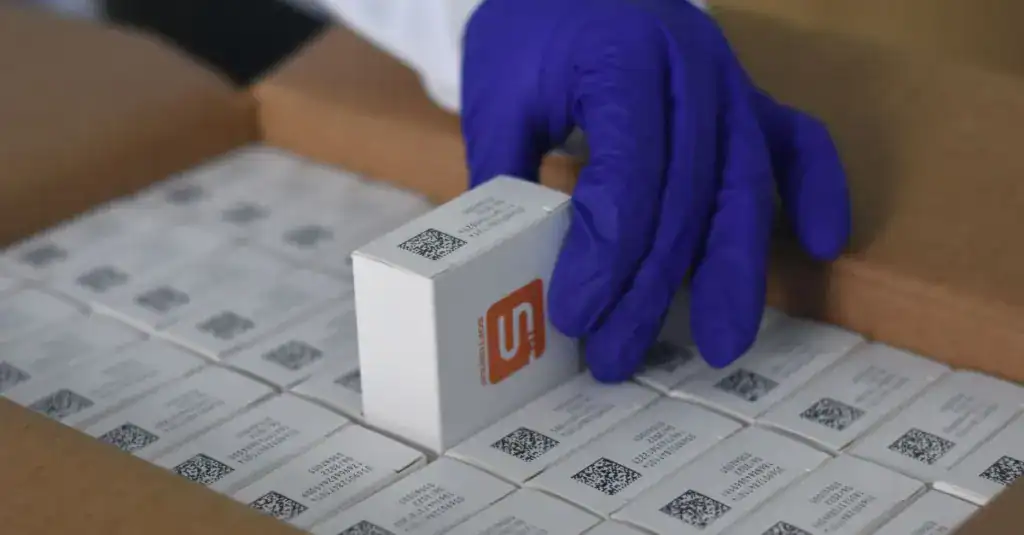
If you're a MAH or CMO assigning GTINs across multiple markets and packaging levels, see how SATT PLATFORM handles GTIN management at scale across EU FMD and non-EU national systems
Difference between GTIN and UPC
There is a difference between GTIN and UPC. Let’s clarify the key distinction between them. The GTIN is the number, and the UPC is the kind of barcode image that contains the GTIN.
GTIN is used for the unique identification key recognized worldwide. GTINs can be 8 (GTIN-8), 12 (GTIN-12), 13 (GTIN-13), or 14 (GTIN-14) digits long.
UPC is short for Universal Product Code. It refers specifically to the 12-digit product identification number used primarily in North America, particularly in the United States and Canada. It is primarily associated with consumer goods.
In the pharmaceutical industry, the GTIN-14 barcode is among the most used.
GTIN-14 is a 14-digit number used to uniquely identify pharmaceuticals, medical devices, and similar products traded in the supply chain at various packaging levels. It’s common in the pharmaceutical supply chain, where products are packaged in larger quantities for distribution to pharmacies, hospitals, and other healthcare facilities.
Who will create GTIN for pharma products?
The Global Trade Item Number is the globally unique GS1 Identification Key used to identify trade items and one of the main building blocks of the GS1 System. GTINs are assigned by the brand owner of the product and are used to identify products as they move through the global supply chain.
The GS1 System provides clear, structured data standards and management rules that manufacturers follow when allocating GTINs to assure that their GTINs are globally unique and in a consistent format.
There are three basic steps for assigning a GTIN:
License a GS1 Company Prefix or a single GS1 GTIN
GS1 licenses a GS1 Company Prefix that provides the foundation for generating GS1 Identification Keys. For businesses that only need to identify a small number of products, individual GTINs can be licensed outside of a GS1 Company Prefix. For those who license a GS1 Company Prefix, the company assigns and generates their own GTINs based on their GS1 Company Prefix, GS1 Standards, and GTIN Management Rules.
Define the product data
When a company assigns a GTIN, it also defines a prescribed set of data that describes the product. This product information defines core data that is consistent across all instances of the product (e.g., size, color, brand information).
Share through the supply chain
The GTIN and associated product information are then saved in a database and shared among supply chain partners to support their operations and systems.
Why do we need serialization in pharma even after having GTIN
Serialization in the pharmaceutical industry is necessary even with the use of GTIN codes.
This is because the GTIN provides a unique identifier for the product type, but in the process of serialization every individual product unit gets its own serial number.
Serialization involves assigning a unique serial number to each unit of a product — such as each bottle or blister pack. This level of detail allows for precise tracking of each unit throughout the supply chain.
Moreover, serialization helps in the fight against counterfeit drugs by making it more difficult for counterfeiters to replicate products. Each serialized unit can be verified as genuine, reducing the risk to patient safety. Verifying the authenticity and traceability of pharmaceutical products enhances confidence in the healthcare system.
Serialization as a solution adds a layer of security to the pharmaceutical supply chain. It allows stakeholders to detect and investigate suspicious or illegitimate products, reducing the risk of unauthorized diversions or tampering.
How GTIN connects to EU FMD compliance
The GTIN is the foundation layer of EU FMD compliance. Under Delegated Regulation 2016/161, every prescription medicine sold in the European Economic Area must carry a unique identifier consisting of:
- Product code — typically the GTIN
- Serial number — unique per pack
- Batch / lot number
- Expiry date
- National reimbursement number — where applicable (e.g., Germany’s PZN, Italy’s Bollino, France’s CIP)
The GTIN alone is not enough for EU FMD compliance. It must be combined with:
- Pack-level serialization at the production line
- Aggregation from unit to case to pallet
- NMVS verification at point of dispense
- Audit-ready evidence mapped to Delegated Regulation 2016/161
For organizations operating outside the EU, similar logic applies to national systems like Tatmeen (UAE), CRPT (Russia), ASL Belgisi (Uzbekistan), NHRA-MVC (Bahrain), and DVTIS (Azerbaijan) – each with their own national identifier requirements layered on top of the GTIN.
Learn more:
Frequently asked questions about GTIN in pharma
How many digits is a pharma GTIN?
Most commonly GTIN-14 (14 digits) for case and pallet level packaging, and GTIN-13 (13 digits) for the consumer unit (smallest sellable pack). GTIN-8 and GTIN-12 exist but are rarely used in pharma.
Who assigns the GTIN to a pharma product?
The brand owner, typically the Marketing Authorisation Holder (MAH), uses a GS1 Company Prefix licensed from GS1. The brand owner is responsible for ensuring each GTIN is globally unique and properly registered.
Is the GTIN the same as the serial number?
No. The GTIN identifies the product type (e.g., “Paracetamol 500mg, 20-tablet pack, Brand X”). The serial number identifies the individual pack (e.g., “Pack #847291 of that product”). EU FMD and most other regulated markets require both.
Does every market accept the same GTIN?
The GTIN is globally unique, but national markets may add additional identifiers on top. For example, NHRN codes in some EU countries, NDC in the United States, PZN in Germany, or Bollino in Italy. The GTIN itself remains the global anchor.
Can the same GTIN be reused across different markets?
Yes, that’s the point of a globally unique identifier. A single GTIN can identify the same product across all markets where the brand owner sells it. National authorities then layer their own identifiers on top where required.
Talk to a serialization expert
Need help implementing GTIN management across multiple markets, packaging levels, or contract manufacturer networks?